
Gamaliel and Paul: A Socratic Dialogue on Law, Messiah, and Transformation
A conversation between teacher and student
In Acts 22:3 the Apostle Paul recounts that though born in Tarsus of Cilicia, he had come to Jerusalem as a young man to study at the feet of Gamaliel. Gamaliel’s teachings would have had a profound impact on Paul’s worldview and would have instilled in Paul a deep knowledge of the intricacies of the Torah. The Socratic dialogue below explores Paul’s post-conversion theology with his former mentor Gamaliel.
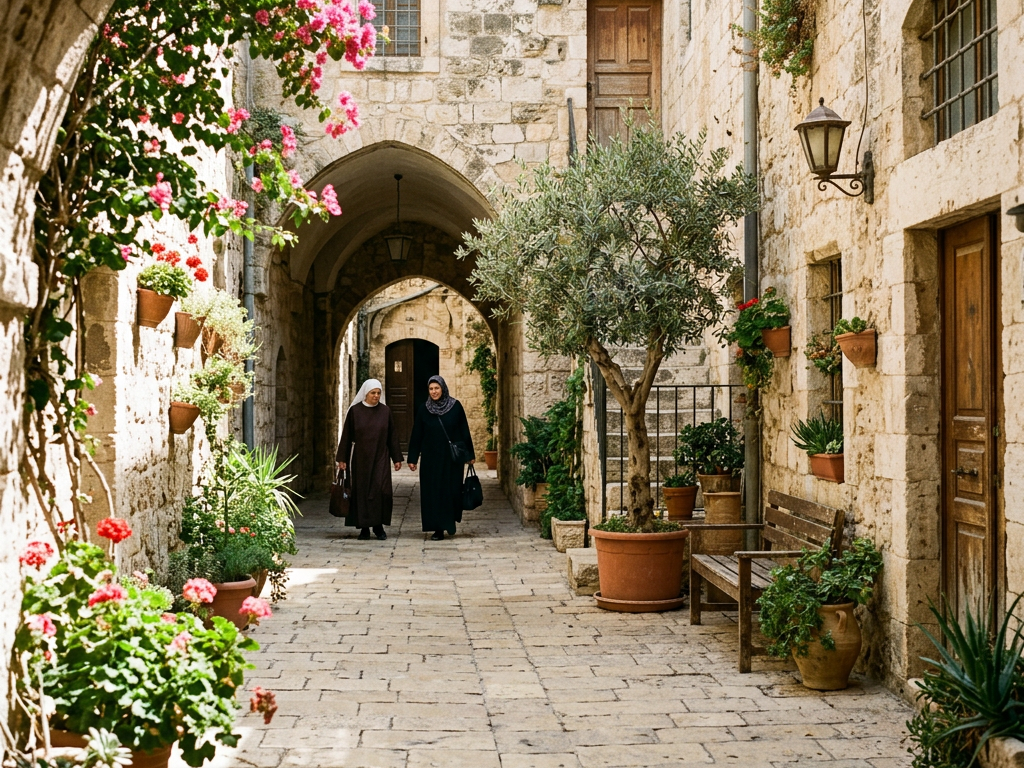
Setting: A sunlit courtyard in Jerusalem. Gamaliel, a respected Pharisee and teacher sits on a low stone bench. Paul, formerly Saul, approaches him, his demeanour transformed.
Paul: Shalom Rabbi. I have come to speak with you, though I know my words may be unwelcome.
Gamaliel: Saul? Is that still you? Your zeal for the law was once unmatched. What brings you to me now, after your departure?
Paul: Rabbi, I have encountered the Messiah—not merely as future hope, but as present reality. Jesus of Nazareth has revealed himself as that “messianic presence” which simultaneously transcends time and brings all traces to fulfillment in a single instant of revelation.
Gamaliel: You speak strangely, my former student. The Messiah enters through the “strait gate”—yes, this we know from our teachings. But a crucified Galilean? Have you forgotten what is written: ‘Cursed is everyone who is hung on a tree’?
Paul: Rabbi, consider this carefully. When the Second Temple was destroyed and the Shekinah went into exile, did not our sages teach that the divine presence would one day return? I have come to understand that the Messiah enters disjunctively “behind the veil” through this very instant you speak of, reclothed in the garments of each letter of Torah itself.
Gamaliel: leaning forward with interest You intrigue me, Saul. Explain what you mean by this “reclothing.”
Paul: The infinite light that was once contracted in the law now manifests through the Messiah’s person. At the moment of his death and resurrection, the center took hold of our being in time—manifesting as an uncovering, an entrance of divine Will that transcends reason and knowledge. This leads to the simultaneous immediate fulfillment of Torah itself.
Gamaliel: But surely you do not suggest the law becomes void? The Torah is eternal, unchanging.
Paul: Not void, Rabbi, but glorified! The law becomes glorious and intensifies its energy upon the Messiah’s entrance. Yet we must acknowledge a painful truth—we are condemned by law before we are conditioned for grace. The law thereby reaches its ultimate purpose, its telos, in the Messiah.
Gamaliel: stroking his beard thoughtfully This is troubling, Saul. Are you saying our efforts at righteousness through Torah observance are meaningless?
Paul: Rabbi, let me ask you this: Have you observed how even our most righteous acts can become expressions of what the Greeks call “self-reflection”—attempts to “be” ourselves rather than to be in communion with the Eternal? Like Adam and Eve, we paradoxically attempt to realize the image of our Creator by separating ourselves from Him.
Gamaliel: pausing You speak of the knowledge of good and evil… the subtle evasion of our true nature.
Paul: Precisely! This replacement of God’s image with self-image is “bad faith.” We cannot exercise true self-control through will alone, no matter how diligently we try. The human soul, despite our best intentions in Torah observance, remains caught in this circular movement of self-love and self-deification.
Gamaliel: Then what do you propose as the remedy?
Paul: The Messiah demonstrates that authentic moral life is death and resurrection. As Jesus taught, to live, one must lose their life—relinquishing self-sufficiency and self-assurance to embrace the voluntary death of the cross. In return, we receive the gift of divine grace, which reverses Adam and Eve’s movement toward self-love.
Gamaliel: You speak of grace… hesed. But how does this relate to our covenant obligations?
Paul: Rabbi, the covenant’s climax is indeed a free and open gift to all—not a judgment, but a feast, the feast of hesed! The Messiah satisfies the demands of the covenant through his faithfulness—his emuna—vicariously suffering for the other by acting as mediator between the essence of God and the creature.
Gamaliel: contemplatively So you suggest that this Jesus, as the archetypal man, assumes all culpability of the original covenant upon himself?
Paul: Yes! Through the Messiah’s faithfulness in his death, covenantal renewal takes place and is bestowed upon the one who appropriates it by faith. At the point where Messiah enters, the law becomes inoperative in its condemning function—each letter of the text is internalized, joined to the “breath” of Torah itself.
Gamaliel: This “breath”… you mean the ruach?
Paul: Indeed. As I receive this gift, there is an emptying of space—kenosis—to make room for “the other.” This union of human conscience with divine presence is the true fulfillment of Torah. The Messiah, whose root is in the essence of the light of the infinite, descends to identify with “the other” so that through hesed, each person becomes a receptacle of meaning and receives a new identity.
Gamaliel: leaning back Saul, this transformation you describe—is it merely metaphorical, or do you claim it occurs in present reality?
Paul: Rabbi, rebirth is not a fantastic event in some future eternity, but happens “in the present time” as a transmutation of the inner person. A more timeless consciousness develops as our personalities become dominated by the Messiah’s will and inner nature. Over time, this consciousness turns the will against itself in true repentance, turning away from the world of representation and strife.
Gamaliel: And you believe this reversal of will leads to what kind of existence?
Paul: To authentic personhood! The natural character of desire becomes transformed—we become “just persons” who suffer willingly for the good of “the other.” The community of faith abandons judgment of what is “good,” transcending the imperfect reality of law, trying always to see everything through the eyes of the beloved.
Gamaliel: nodding slowly This reminds me of Micah’s words: “To act justly and to love mercy and to walk humbly with your God.”
Paul: Exactly, Rabbi! This represents the inward restoration from self-interest to an insatiable desire to please God, expressing itself in care for “the other” in a culture hungering for divine goodness and mercy.
Gamaliel: But tell me, Saul—if the Messiah has suffered and died, how does he continue to effect this transformation?
Paul: Through his resurrection, Rabbi. The Messiah’s resurrection does not occupy a particular place or time—it is an event hidden within God’s eternal being. By resurrection, the Messiah’s being “confronts the nothingness present in all perishability,” defeating death by transforming it from within.
Gamaliel: standing and pacing This is extraordinary, Saul. You’re suggesting that through this Jesus, humanity is given intimate share in the very being of God?
Paul: Yes! A synthesis of the unchangeable and the perishable, of being and existence, is achieved. The self enters this same event, appropriates the Messiah’s faithfulness, and experiences covenantal union. The transformation moves us from pursuing self-knowledge to knowing the Messiah, and hesed imparts the pure relation of power to suffer this self-emptying for “the other.”
Gamaliel: This power you describe—it goes beyond natural human strength?
Paul: It is an infinite “striving”—what the Greek philosophers call epektasis—an incessant stretching out of one’s being in desire to be satisfied with God’s love. This hidden power enables us to assume a “sacrificial position” and reach out in mercy, even to our enemies.
Gamaliel: sitting back down, visibly moved Saul, I confess your words stir something in my heart. You speak of the Messiah as both the fulfillment of our deepest longings and the complete transformation of how we understand covenant relationship.
Paul: Rabbi, the binaries of law and faith are interrelated—one differs and defers from the other. Faith is an event concurrent and instantaneous with its antecedents, a simultaneous relation of past, present, and future. Through the Messiah’s sacrificial death, an inner and outer totality of being opens up, leading to transformation from inauthentic to authentic life.
Gamaliel: And this transformation—it is available to all people, not just the children of Abraham?
Paul: The covenant’s fulfillment is indeed offered to all! The Messiah inaugurates the ultimate unification and rectification of Jews and Gentiles. His sacrifice creates a new covenant that covers transgressions, and his Spirit enables all who trust to walk in this new life—a life that fulfills the true intent of Torah through love rather than mere external observance.
Gamaliel: after a long pause Saul, you have given me much to contemplate. If what you say is true, then this Jesus represents not the destruction of our tradition, but its ultimate flowering—the moment when divine presence returns from exile and Torah itself finds its deepest expression through divine love dwelling within human hearts.
Paul: Rabbi, you understand well. The Messiah is the archetype of every human life and the embodiment of Torah itself. He renews the entire created order and re-enacts the archetypal covenantal action of freeing and integrating the unconscious life as individual conscience is transformed by the movements and energy of the divine spirit.
Gamaliel: rising slowly Then perhaps… perhaps I must reconsider what I thought I knew about the ways of the Almighty. Your words challenge everything I have taught, yet they do not destroy—they seem to fulfill in ways I had not imagined possible.
Paul: Rabbi, this is all I ask—that you examine these things with the same careful attention you once taught me to give to the sacred texts. For in the end, it is not about abandoning our heritage, but about discovering its ultimate purpose: the transformation of human hearts through divine love, the establishment of authentic justice through self-giving hesed, and the restoration of true communion between the Creator and His creation.
Gamaliel: Go in peace, my former student. Though I cannot yet embrace all you have shared, I cannot dismiss it either. You have shown me that perhaps the deepest truths of our faith are not possessed but received, not achieved but bestowed, not earned but gifted through divine grace.
Paul: Shalom, beloved teacher. May the light of the Messiah illuminate your path as you continue to seek truth.
As Paul departs, Gamaliel remains in the courtyard, gazing up at the sky, his heart stirred by possibilities he had never before considered—that the very presence of God might dwell not just in temple or Torah scroll, but within the transformed hearts of those who trust in the promised Messiah.
Biography:
Born in Cyprus, Nicos Kaloyirou migrated to Australia with his family at the age of twelve. He was educated at the University of Adelaide in South Australia, where he earned both a Bachelor’s and a Master’s degree in Law. It was during his university years that Nicos came to faith in Christ, a spiritual turning point deeply influenced by the book The Genesis Flood by Whitcomb and Morris.
Nicos currently practices as a lawyer in South Australia. Alongside his legal career, he is an active writer whose work spans both creative and academic disciplines; he has published a legal article on “Causality” in the Flinders University Law Journal, as well as poems and articles in the AP online journal (Australian Presbyterian Church). Three of his poems are forthcoming in Heart of Flesh Literary Journal this November.
Discover more from PAROUSIA Magazine
Subscribe to get the latest posts sent to your email.


