
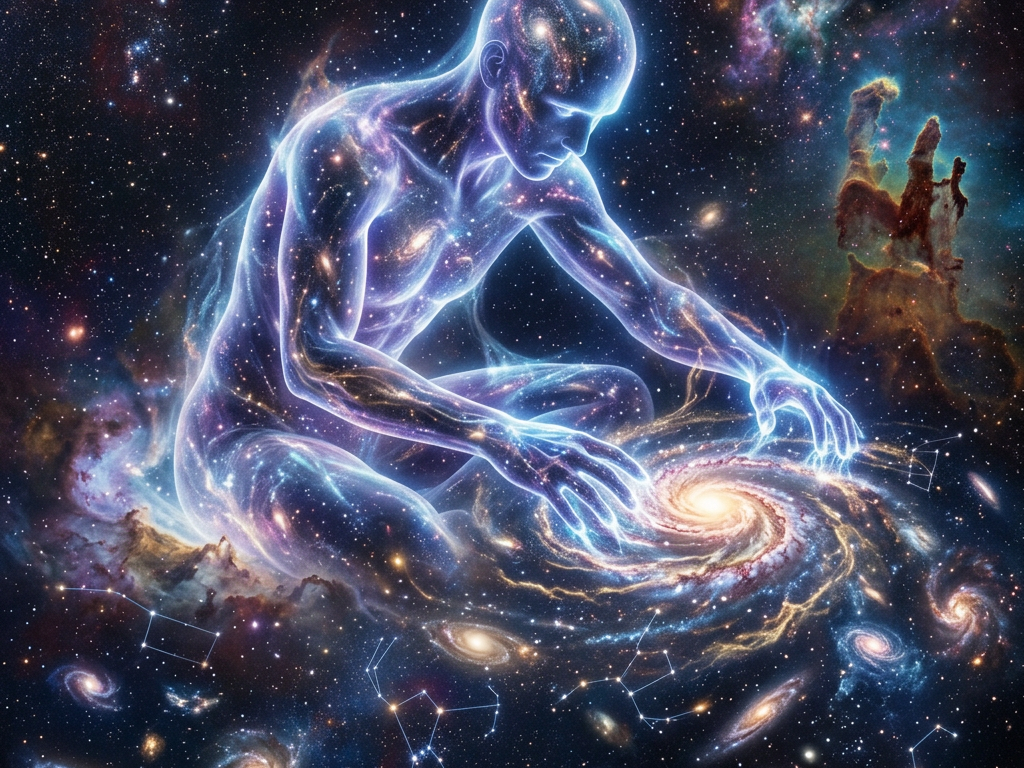
Imagine you are the architect of existence, a timeless entity lounging in the infinite expanse of your cosmic home. In the attic, a grow tent hums with potential ~ a void we'll call "Space." You introduce a fragment of a larger world, a clod of Earth, into this void. Silence. A seed follows, nestled in the soil. Stillness. Water, measured with the precision of a creator, is added. Yet, nothing stirs.

Then comes light ~ a sun in miniature. As it floods the tent, life flickers, a seedling stretching towards the glow, only to falter, burned by an excess of love. The lesson is clear: creation demands balance. Not too close, not too far, but a perfect harmony. Yet, even with care, the plant's life is fleeting. The enigma? Time itself. A cycle of light and darkness, measured in hours, is needed. Water, air, and light dance to a rhythm you conduct. But what happens when the creator needs to step away?

Enter the timer ~ a mechanical heart beating in sync with the plant's needs. It flips switches, releases moisture, and whispers breezes, freeing you from the cycle. Just as the Earth was once a barren rock adrift in the cosmos, until a cataclysmic birth ~ the moon ripped from the Pacific, birthing time as we know it. Now, the moon, a celestial clock hand 238,900 miles distant but round it off 240,000 miles (or 24:00:00 in cosmic code), dictates our days. Should it drift further, our hours would stretch, our days lengthen. The moon, our natural timer, marks the dawn of time's dominion, a moment before which existence was unbound by its constraints.


Author Biography:
Seemak M Macull is a writer whose work focuses on deep existential, philosophical, and speculative themes. He is writing from Scotland.
Discover more from PAROUSIA Magazine
Subscribe to get the latest posts sent to your email.


