
ROBERT
Molly Williams came to Victory in Biloxi, Mississippi from the suburbs of Philadelphia, about as green as a colored girl can get. She hadn’t been a Christian six months. The college administration put her in a dorm room with the only other black person on campus, a big closet lesbian named Florence.
I come from a little place north of Jackson where they had some Klan trouble a few years back, if you remember your nightly newscasts. I was a junior at Victory the year that Molly and Florence came aboard. Florence and I had grown up about ten miles apart, and I knew her little secret, though she didn’t know that I knew. She was a heavy girl, and not at all pretty. You could see she had her eye on Molly, who was as unpretentiously good-looking as any black girl I’ve met in a long time.
Bless her dear little heart, Molly hadn’t the faintest. She was a friend to Florence, loyal and true, and where you saw one you usually saw the other. Florence had a host of problems, any one of which would have gotten her shipped from our little fundamentalist college had Molly let it slip. The biggest problem, of course, Florence did not confide.
You could see the makings of some decent Christian character in Molly that year. She was not punctual, however, and as the year went on you could also see that she was having some reservations about the total Victory Christian College package, which could not be purchased piecemeal.
There was strong dissension that year between administration and students, with militant factions emerging on both sides. Molly tried to love both sides, and that, of course, endeared her to neither.
I remember a trip that year to a downtown rescue mission. Molly and I and a few others dutifully made the trek into the wasteland. (I knew the locality–the mission sat two buildings down from a well-advertised adult movie theater.) I still remember Molly’s amazed reaction to some of the human flotsam we saw down there. She didn’t know her own race lived that way. She went back. Once was enough for me.
Molly lived off-campus her sophomore year with an elderly faculty couple. Florence drove to Philly that fall to ferry her to school, for reasons Molly did not begin to fathom, and all the way down she tried to talk Molly into living off-campus with her. Molly was amenable to the idea, but arrangements had already been made with the faculty couple, and for that reason, and others, Florence’s plan fell through. Florence herself did rent an apartment on Jackson Street, but you could see she was peeved at not being the center of Molly’s attention anymore, though I hear that Molly went out of her way to spend time with the girl. Florence eventually drifted out of school and out of town and out of Molly’s life.
I graduated in 2008 and took a job with a legal firm in Memphis. Friends at the school kept me posted on developments there, particularly those concerning Molly, for whom I felt a special concern. I had sided with the administration in the schism two years earlier, but in my absence, a series of events caused me to slowly re-evaluate my position. Molly, for her part, had a rapprochement of sorts with the administration and became quite a wheel on campus–editor of the yearbook, factotum for certain faculty members, chairman of the student missionary committee, and et cetera. During her tenure there the missionary committee began a strong emphasis on home missions, particularly the work with derelicts, with lack of attention to foreign missions the inevitable result. Allowing that to happen was one of my grievances with the administration. Their cowardly pursuit of humanistic “accreditation” was another.
The day she graduated, Molly went back to Philadelphia, but not to the suburbs this time. She went straight to a place called Richardson Projects, a vast wilderness of drugs and crime and human stench, and began, of all things, a rescue mission. Right there in the heart of (literally and figuratively) darkest Philadelphia. A couple years later she started a crisis pregnancy center in one of the rooms in the mission. Three years after that she rented a rundown building across the street and opened a combination Christian coffeehouse/rec center for youths of the neighborhood. Dying bodies careened out windows all around her, bullets periodically ricocheted around and through her facilities, while a drug trade comparable to the gross national product of Latvia flourished in the very heart of the neighborhood she chose to live in. None of this deterred her from spreading the good word about Jesus to the natives. She was one determined girl–naive and foolish, but determined. She could not see the inevitable deterioration in her own life.
Somewhere along the line, the Secretary of Health and Human Services gave her a commendation, drawing considerable media attention to her programs. She got quite a bit of press from a number of liberal journalists, all of it favorable. The folks at Victory didn’t know exactly what to make of the situation. I, however, was not confused.
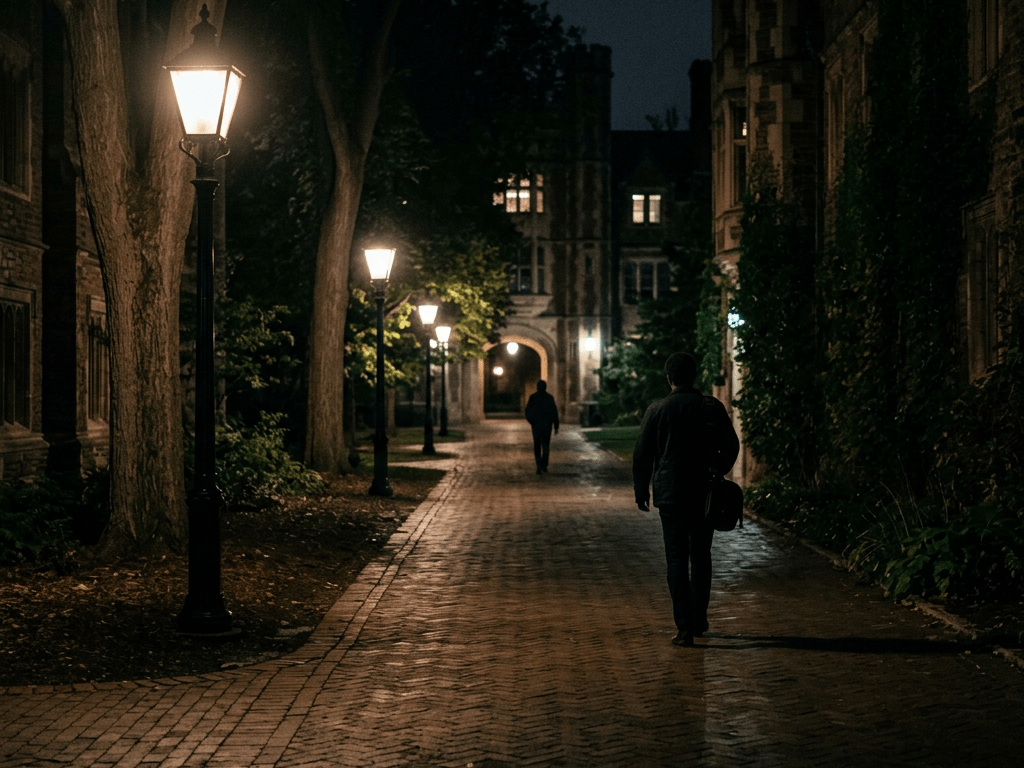
I saw Molly again, in 2018, at an alumni banquet. I had checked Cale Everhart’s list beforehand to make sure she was coming. After the banquet, I and Molly and two of my old friends stopped at a local McDonald’s for an ice cream sundae. The conversation tarried, my friends left after an hour or so, and I and Molly sat by ourselves in the restaurant. Eventually we got up and walked out into the parking lot. Outwardly, she had changed little since college–gotten prettier, perhaps, if such a thing were possible–not much else. Still naive, stubbornly so. We stopped beneath a light pole.
“Molly, you could have married a black preacher and had yourself a big ministry somewhere.”
I’m pretty sure she blushed, though experience has taught me it’s hard sometimes to tell with a colored girl.
“What might have been. Johnny, after you spend a few years doing what I’ve done, certain things don’t seem so important anymore.”
“Do you ever think about getting married?”
“He’d have to have a mighty adaptable schedule.”
“What about the headship of the husband?”
“What about it?”
“Don’t you think that would affect your lifestyle?”
“It probably would. Why do you think I’m still single?”
We were walking away from the light now, pausing occasionally, walking a little more.
“Molly, what did you ever know about Florence?”
“She was an enigma, Johnny. Darkness and light all rolled up into one puzzling package. She could be very bitter. But she had a remarkable sense of humor–kept me in stitches sometimes. Do you know what she did for a hobby? Crossword puzzles. She could do one of those things so fast it would make your head spin.”
“Did you know she was a lesbian?’
“I kind of figured it out, yes.”
“When did you come to that conclusion?”
“About halfway through our freshman year.”
“What made you suspicious?”
“Little things here and there. Pictures she looked at in magazines. Her reaction to other girls. I just came to the place, finally, where I knew.”
“So you knew she was a lesbian when you let her drive you back to school your sophomore year.”
“Yes. Are you surprised?”
“I really thought better of you than that, Molly.”
“Are you supposing I was inclined that way myself?”
“Heavens, no. Nothing like that. It’s just that, well, I happen to believe you should keep your distance from certain things.”
“Johnny, I loved that girl. She was one hurting individual. I know some of the things that put her on the path to homosexuality. Some of the things that happened to her in her childhood were very traumatic.”
“She chose homosexuality, Molly.”
“Like we’ve all chosen some things, Johnny. And yes, we are responsible for our choices. But God loves us even when we make the wrong one.”
“Molly, I had a talk with Florence not too long ago. She told me some pretty startling things about the two of you. She admitted to fantasizing about a relationship with you on a number of occasions. Does that shed a different light on your friendship with her?”
I did not add that she made this confession while under considerable duress.
“Why do you think I chose not to live off campus with her?”
“Do you remember a walk you and she took on the beach your freshman year?”
“Good gracious, Johnny, we wore paths in the sand that year. It could have been any one of a number of nights.”
“Molly, Florence told me she was thinking that night of, well, of having sex with you.”
“Johnny, she never did anything inappropriate. Not once.”
“She thought about it considerably.”
“Johnny, if I didn’t believe the Lord could keep me safe, I certainly wouldn’t be where I am now.”
“Molly, she claims she saw, on several occasions, a rather large and muscular black angel named Robert. Says he nearly scared her to death.”
“She could have been hallucinating, Johnny. You know she did some pretty nasty drugs.”
“I know.”
“Or it could have been an angel. Stranger things have happened. Like us getting nominated for that commendation. That was strange. The coincidences that caused the Secretary to be exactly where he could talk to a person who knew someone who knew someone else who had heard about our work. Only they weren’t coincidences. You have no idea how much good has come out of that medal. We have access now to resources that we couldn’t have begun to tap before.”
“Molly, Florence came to an untimely end. Some sicko Klanboy carved her up pretty badly–threw her body in a dumpster.”
“No.” Her jaw sagged, and I could almost literally hear the blood rushing to her head.
“Molly, forgive me for putting it so crudely. It was in the newspaper. This fanatic with a switchblade kind of did her in. I truly am sorry.”
And I was, to an extent–at least for getting carried away with the knife. But Florence was trash, the same kind of trash that even a beautiful girl like Molly had become. And trash needs to be taken out.
We walked a few more steps before she replied.
“Johnny, do you know I’d been praying for that girl since the day she left Victory? Since the day I met her, for that matter. Oh, Florence!”
She let out a long breath, turned, then took two steps toward the road. We had maneuvered into a darkened area by now, but there was enough light for me to see the tears sliding quietly down her face. Something in my heart almost snapped.
“Molly, there’s something I need to talk to you about.”
“Go ahead.”
“Molly, has it ever occurred to you that certain people take a dim view of your assorted projects there in Philadelphia?”
“What do you mean by that?”
I honestly don’t think she knew what I was talking about.
“Well, some people might feel like that neighborhood you’re working in could better be abandoned–closed up to outsiders–left to ferment and explode. Sort of like letting a subhuman class of people just write their own exit lines to the historical drama, if you want to use a literary comparison.”
“Do you feel that way, Johnny?” She gave me a strange look, a very strange look.
“Heavens, no. But Molly, has it ever occurred to you that sooner or later you might die a–well, for lack of a better term, let’s just say ‘unnatural’ death?”
She looked directly into my eyes, and this time I knew she knew. There was a long pause.
“Johnny, I’ve thought about that,” she said finally.
I believe her face, like Florence’s before her, had gone a shade whiter.
“Molly, be reasonable. You could do some wonderful things for the Lord somewhere else.”
“No. That is where God called me, and that is where I’m staying.” Good Lord, but the girl was stubborn.
“Please.” My hand was on the switchblade in my pocket.
“I’m sorry. But I just can’t. Johnny, I really need to be going.” She began turning to leave. The knife was out now, opened, moving.
I heard Robert before I saw him. He spoke softly, almost gently, but every word was etched in granite.
“Klanboy, put that knife back in your pocket before someone gets hurt.”
And then I could see him vividly through the darkness, an incredibly huge person, shiny ringlets curled tight to his scalp, massive black muscles bulging through his white “Jesus is Lord” T-shirt.
Molly was walking away from me now, and he was walking with her to her old Toyota, standing patiently while she fumbled with her keys, watching while she finally opened the door and got in, watching still as she drove out of the parking lot and headed northward down highway fifteen.
And then he was gone.
Biography:
Charles Eggerth lives in Advance, NC. Born in southeastern Minnesota in 1952, he graduated from high school in northwestern Iowa in 1970. After obtaining two B.A. degrees, he taught for six years before joining the United States Postal Service. He retired at the end of 2019 after 33 years of service. His previous publications include a short story and several poems.
Discover more from PAROUSIA Magazine
Subscribe to get the latest posts sent to your email.


