
For the seventy-ninth consecutive year, someone had brought Adolf Hitler.
This had become a source of acute embarrassment for the rest of the table, though Wrath remained convinced his guest represented the pinnacle of human wickedness. The other demons had grown thoroughly tired of his speeches, his laminated charts, and his insistence that the judging was rigged.
When Wrath marched into the dining hall with the former dictator in tow, a collective groan rose from the assembled company.
“Oh, for Heaven’s sake,” someone muttered from the far end of the table.
The room went dead silent. Among the damned, it was considered poor form to mention the winning side.
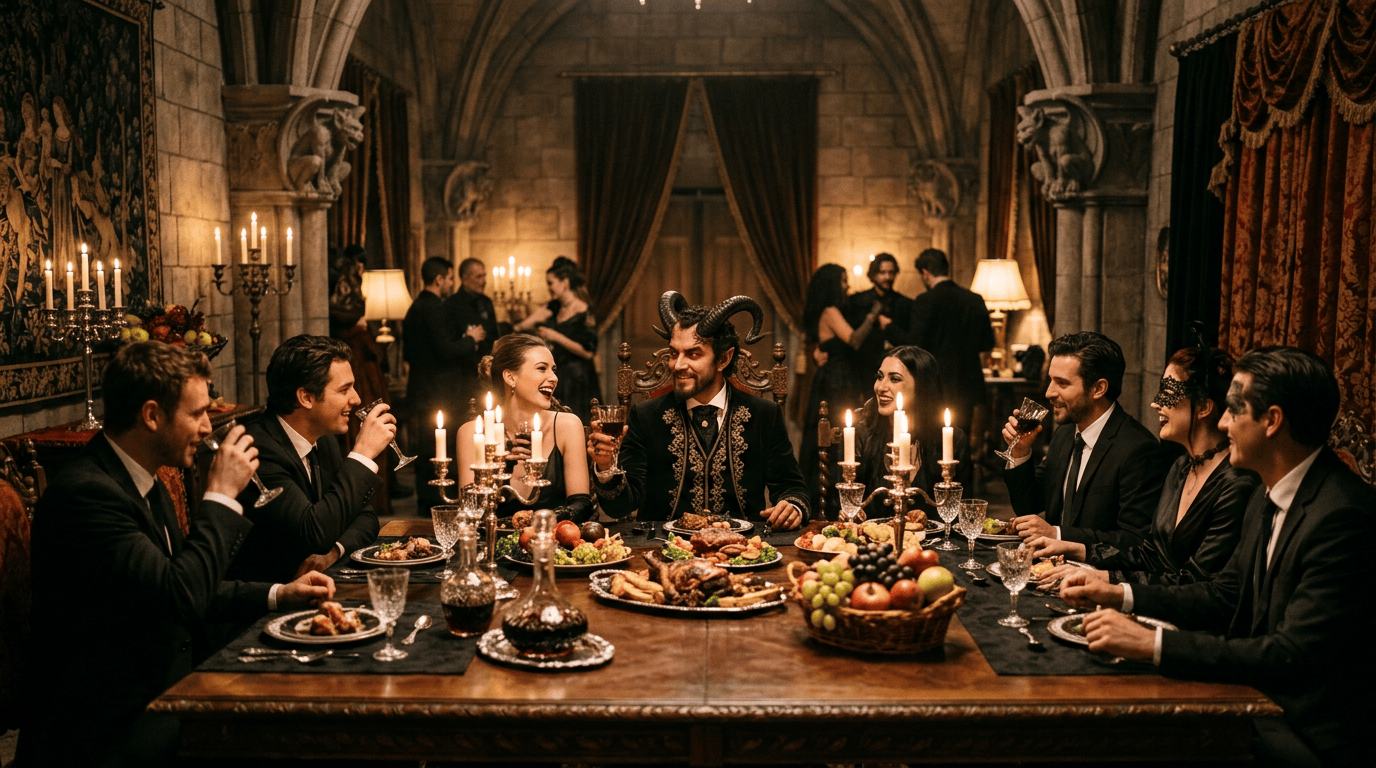
The Devil’s annual dinner was an ancient, deeply petty tradition. Each year, seven demons presented the human souls they considered their greatest achievements. Their host judged the cunning of the deception rather than the scale of the wickedness, a distinction Wrath disputed whenever he lost. The winner’s name was engraved upon a brass plaque beside the dining room door. The honor carried no authority, granted no privileges, and altered nothing about the eternal misery of anyone involved. Naturally, the demons regarded it as the most important night of the year.
The dining hall looked like a palace designed by someone who had heard descriptions of Heaven over a bad connection. Towering black marble columns supported a vaulted ceiling, and crystal chandeliers blazed above a mahogany table long enough to seat a royal court. Oil portraits of kings, conquerors, and tyrants lined the walls. Their painted eyes tracked the guests as they moved, a touch the demons considered the height of good taste.
At the far end of the room stood an enormous grandfather clock. Its brass hands remained frozen at twelve, though its pendulum swung and ticked without rest. Time was a disagreeable subject here. The condemned had none left, and the demons had far too much of it. Everyone pretended to ignore the clock, though nobody could tune it out.
Hooded servants glided between the high-backed chairs, carrying silver platters piled with herb-roasted meats, warm bread, and glistening fruit. Crystal pitchers held ice water, their sides beaded with cold sweat. The demons ate and drank freely. Their human guests sat rigid before identical place settings, strictly forbidden to touch a single crumb or take so much as a sip.
Around the enormous table sat the human souls selected for this year’s consideration. A few looked terrified. Others appeared dazed, while several maintained the stiff, offended posture of people who had spent their entire lives expecting special treatment.
Near the head of the table, a man wore heavy velvet robes of royalty, though his crown was conspicuously missing. He sat with his chin tilted up, gripping the carved arms of his chair as though granting an audience. Across from him sat a woman in a silk evening gown. A diamond necklace rested against her collarbone, and her fingers twitched toward it whenever anyone glanced her way.
Beside them, a handsome man in a tailored tuxedo studied his reflection in the back of a polished silver spoon. He smoothed his hair, flashed a practiced smile at his own image, and looked mildly offended when nobody noticed. Farther down sat a silver-haired gentleman with his hands neatly steepled before him. He wore a crisp dark suit and the serene, practiced expression of a man accustomed to speaking while crowds nodded along.
Next to him sat a heavyset man whose entire world had narrowed to the golden roasted pheasant on his plate. Sweat beaded on his upper lip as he tracked the passing servants, his jaw working silently with every dish that went by.
And then, of course, there was Hitler. The former dictator sat hunched in silence, staring at his empty hands. Wrath had positioned him dead center at the table, like a centerpiece meant to intimidate the room. Nobody gave him a second glance.
Each demon occupied a high-backed chair beside the human soul they had brought. Only two seats remained empty, side by side near the foot of the table, as far from the Devil’s ornate throne as possible.
Naturally, Sloth arrived last.
Sloth wore an off-the-rack charcoal suit with a plain white handkerchief folded neatly into his breast pocket. He carried no staff, wore no rings, and entered without a shred of ceremony. Behind him walked an ordinary man in a slightly wrinkled blue button-down shirt, dark slacks, and scuffed brown loafers. A gold wedding band rested on his left hand. He looked like a guy from accounting, a Little League coach, or the neighbor you waved to while taking out the trash.
The table went quiet as the demons stared. Then Wrath barked out a laugh.
“Is that seriously your guest?” Wrath asked.
“It is,” Sloth replied mildly.
“Did you snatch him from a bus stop?”
“Something like that.”
Pride set down his crystal goblet with a soft clink. “Who is he?”
“A man,” Sloth said.
“Yes, thank you, we’ve established that. What did he do?”
Sloth paused, as if genuinely weighing the question. “Very little.”
Wrath laughed so hard he sloshed wine onto the tablecloth.
The man barely heard them. His eyes had locked onto a pale face halfway down the table. He was a man with a narrow, toothbrush mustache, and a cold wave of panic washed over him. He couldn’t fathom what terrible clerical error had landed him in the company of monsters.
He turned to Sloth, his voice tight. “My wife,” he whispered. “Did something happen to my wife?”
Sloth pulled out the heavy wooden chair beside his own. “Please. Take a seat.”
The man sat, his knees weak. A fragmented memory flickered behind his eyes: a sudden, crushing vice around his chest, the linoleum floor rushing up to meet his cheek, and the ragged whistle of his own shallow breathing. He had tried to shout for help, but nothing came out. Blinking, he had found himself standing in this marble hallway.
A hooded servant materialized beside him and set down a crystal goblet. Ice water filled it to the brim, a single cube clinking softly against the rim. The man stared at a bead of condensation tracing a slow path down the glass. His throat felt lined with sandpaper. Almost without thinking, his hand crept forward.
Sloth’s fingers clamped around his wrist like cold iron. “I wouldn’t.”
The man froze, staring at him.
“The refreshments aren’t for the guests,” Sloth said quietly. “Trust me. There are far worse rooms than this one.”
The massive double doors boomed shut. Every servant froze in place, and the chandeliers dimmed until the hall was bathed in a sickly amber glow. The seven demons rose as one. Their host had arrived.
The Devil stepped through a narrow doorway behind the head of the table. It was a door that hadn’t been there a second earlier. He looked like a short, plump man in his late fifties, with thinning hair combed straight back, heavy-lidded eyes, and an unkempt salt-and-pepper beard. His bespoke charcoal suit was rumpled, the jacket straining against a single button over his stomach. His collar stood open, and his silk tie hung loose around his neck like a noose he’d given up tightening.
He surveyed the room with the flat, weary expression of a regional manager dragged into an all-hands meeting he had hoped someone would cancel.
“Oh, for crying out loud,” the Devil sighed. “Sit down. What is this, a coronation?”
The demons obeyed. The Devil sank into the oversized chair at the head of the table and accepted a goblet of red wine from a hooded servant. He took a sip, grimaced, and set it down with a sharp clack.
“Terrible,” he muttered.
The servant remained motionless beneath its cowl.
“Oh, don’t look at me like that. I’m not blaming you.” He nudged the glass away with one finger. “Bring me something else. Something that doesn’t taste like fermented regret.”
The servant bowed and melted into the shadows with the wine.
The Devil had staged the entire banquet to mimic a royal court. The black marble, the blazing chandeliers, the silent servants, and the oversized throne were all hollow imitations of a kingdom he would never possess. Ages ago, he had tried to seize a seat above God’s. He had lost. Now he passed eternity playing host at a dinner party.
He could bark orders at servants and decide which demon got a name engraved on a cheap brass plaque. He could not overturn a single judgment that had brought these human souls to his table, and the final sentence hanging over his own head was every bit as inescapable as theirs. Naturally, it was a topic nobody brought up.
Pride rose from his chair and smoothed the lapels of his tailored coat.
“Your Majesty,” he began in a booming baritone, “it is my distinct privilege to welcome you once again to this year’s annual presentation of—”
“Oh, put a sock in it,” the Devil said, waving a hand. “I know where I am.”
Pride stiffened, remaining on his feet. “As master of ceremonies, I have prepared a brief opening address.”
“How brief?” the Devil asked suspiciously.
“Merely a few remarks honoring the storied history of this tradition, its vital significance to our continued—”
“No.”
Pride looked deeply wounded.
The Devil reached automatically for his wineglass, remembered the servant had taken it, and let his hand drop to the table. “Just introduce the guests. I’d like to wrap this up before the next century.”
Pride gave a stiff bow. He had volunteered to act as master of ceremonies three centuries ago and had fiercely guarded the role ever since. He viewed the arrangement as a tribute to his superior organizational genius. The other demons viewed it as a convenient excuse to stay seated.
The Devil let Pride decide the speaking order every year. He had zero patience for pomp and even less interest in micromanaging it.
“Very well,” Pride announced, consulting an embossed index card. “We shall begin with Wrath.”
Wrath shot out of his chair, yanking his guest up by the arm beside him.
The Devil squinted at the man with the narrow mustache. “Oh, Wrath. Hitler? Really? Again?”
“I maintain my guest remains an unmatched candidate,” Wrath replied stiffly.
“Of course you do.” The Devil pinched the bridge of his nose. “Seventy-nine years. Seventy-nine dinners. Seventy-nine identical presentations. I could recite your opening statement in my sleep.”
“Then you appreciate the sheer magnitude of his atrocities.”
“I appreciate that you’ve dragged the exact same plus-one to dinner seventy-nine times.”
Wrath puffed out his chest. “My guest engineered the deaths of millions. He weaponized hatred, unleashed global war, and convinced an entire nation that cruelty was a virtue.”
“Yes, yes. A thoroughly dreadful fellow. We settled that back in the forties.”
“His poison outlived him,” Wrath insisted.
“So has your monologue.”
Around the table, a few demons snickered into their glasses.
Wrath glared around the table. “Surely no other contestant here can match the sheer scale of his destruction.”
The Devil leaned forward, resting his forearms on the edge of the table. “Tell me honestly, Wrath, did you have to break a sweat convincing him to hate?”
Wrath hesitated a fraction of a second. “He was exceptionally receptive.”
“Precisely. You found a man already starving for enemies and handed him a list. That isn’t craftsmanship; it’s bookkeeping.”
“He scarred the course of human history!” Wrath protested.
“And you have spent seventy-nine dinners reading us the footnotes.” The Devil flicked his wrist. “Sit down. Next.”
Wrath dropped into his chair, muttering darkly about rigged judging. Beside him, Hitler sank slowly back into his seat, staring at his empty plate.
At the foot of the table, the ordinary man watched the former dictator sit down. He had seen that face a hundred times in black-and-white history textbooks and late-night documentaries, but in person the man looked shrunken. Ordinary. Almost pathetic. Somehow, that made the horrors he had unleashed feel ten times more chilling.
The man’s gaze swept nervously around the table, taking in the velvet robes, the tailored suits, the diamond necklace. If Adolf Hitler belonged in this dining room, what had the rest of these people done? And what on earth was he doing sitting beside them?
Pride tapped his stack of index cards neatly against the table. “Our next contestant is Envy, presenting a noblewoman of considerable distinction.”
The noblewoman rose slowly. Her pale fingers immediately found the diamond necklace at her throat.
“She poisoned her own younger sister,” Envy purred, “simply because the girl was loved.”
The Devil studied the woman through heavy-lidded eyes. “Loved by whom?”
“Everyone,” Envy said with relish. “Their parents. Their circle of friends. Even the kitchen staff adored her.”
“How positively dreadful.”
“My guest convinced herself that if her sister were out of the picture, all that affection would naturally flow to her,” Envy explained.
“And did it?” the Devil asked.
“Not a drop.”
The Devil smiled faintly. “How terribly disappointing.”
The noblewoman kept her eyes fixed on the white tablecloth.
“She slipped arsenic into her sister’s wine at supper,” Envy continued, “and wore the girl’s finest diamonds to the funeral three days later.”
The Devil’s gaze dropped to the glittering stones at the woman’s throat. “Stunning piece. Wasn’t it your sister’s?”
The noblewoman’s knuckles turned white around the clasp.
“And after the burial?” the Devil asked.
“She discovered that tragedy had turned her sister into a saint. Grief made the dead girl ten times more beloved than she had ever been alive.”
The Devil nodded slowly. “So you persuaded her that someone else’s joy stole directly from her own.”
“Precisely.”
“And the moment she snuffed out that joy, she found herself just as empty as before.”
“Emptier,” Envy replied.
“Very good. A genuinely miserable little achievement.”
Envy gave a theatrical bow, and the noblewoman sank back into her chair, her fingers still locked around the stolen diamonds like a collar.
Down at the foot of the table, the ordinary man looked away, his stomach twisting. He thought suddenly of his own younger sister; of slamming bedroom doors, fighting over the front seat of the station wagon, and keeping score of whose birthday cake had thicker frosting. It all felt absurdly trivial now. Looking at the noblewoman’s rigid shoulders, he wondered if she had spent the rest of her life wishing she could take back a single supper.
Still standing beside his chair, Pride consulted his next card. “Lust presents a musician whose melodies captivated the world.”
The musician rose, adjusted his cuffs, and flashed a charming, practiced smile as though waiting for a flashbulb. The room stayed dead silent.
“He could walk into any room on earth and take whomever he wanted,” Lust said smoothly. “He had money, beauty, and an endless supply of willing hearts.”
“And yet?” the Devil prompted.
“Nothing ever satisfied him for longer than a single night,” Lust replied. “He devoured people like fine wine. Savoring the novelty, draining them dry, and tossing the bottle aside before morning. He left a trail of broken marriages and ruined lives, forever chasing a spark that burned out the moment he caught it.”
The Devil turned heavy-lidded eyes toward the musician. “You had lovers in every port, I suppose.”
The musician gave a tight, reluctant nod.
“And anyone who actually knew your real name?”
The musician glanced desperately toward Lust, who simply smiled and offered no rescue.
The Devil leaned back against his throne. “What a terribly exhausting way to die completely alone.”
Lust gave a sleek bow. The musician sank back into his chair, avoiding his own reflection in the silverware.
At the head of the table, a hooded servant reappeared with a fresh crystal tumbler of dark amber whiskey. The Devil took a cautious sip, rolled it across his tongue, and gave a curt nod.
“Much better.”
The servant bowed and melted back into the shadows.
“Greed,” Pride announced, flipping to his next card, “offers a senator whose influence over the faithful was nothing short of extraordinary.”
The politician rose slowly, buttoning his suit jacket with the practiced, unhurried dignity of a man accustomed to waiting out standing ovations.
“Senator,” the Devil said smoothly. “What a treat. Please, do tell us about your public service.”
Greed stepped in before the politician could launch into a speech. “My guest built an empire upon the Word of God—or at least the verses that polled well. Whenever Scripture failed to endorse his bank accounts or his campaigns, he simply drafted his own.”
The Devil raised a thick eyebrow. “Drafted his own?”
“He fabricated entire verses from scratch. Attributed his campaign slogans to prophets who never breathed a word of them, and assured his donors that every landslide victory was a direct sign of divine favor.”
The Devil looked genuinely delighted. “Did nobody bother to check?”
“Hardly a soul,” Greed replied smugly.
“Not even one?”
“A handful,” Greed admitted. “They were promptly labeled cynics and run out of town.”
“Positively marvelous.”
The senator cleared his throat and stared intently at his empty water glass.
“He was especially fond of quoting the Book of Hezekiah,” Greed added.
The Devil blinked. “The what?”
“The Book of Hezekiah.”
“There is no Book of Hezekiah.”
“No, Your Majesty. There isn’t.”
The Devil barked out a genuine laugh.
“Oh, that is rich. Did he know it didn’t exist?”
“Oh, completely.”
“And his flock?”
“They preferred the thunder of his certainty to the inconvenience of opening a book.”
The Devil wiped a tear from the corner of his eye. “Senator, I was hoping you’d brought your Bible tonight.”
The politician stared straight ahead, jaw clenched.
“Never mind,” the Devil chuckled. “You certainly never needed one before.”
Greed gave a satisfied bow. The senator sank back into his seat and smoothed his silk tie.
Down at the end of the table, the ordinary man studied the senator’s profile. He had known men like that back home. Guys who wore their faith like a campaign button on Sunday mornings and tucked it into a drawer by Monday afternoon. He had always despised that brand of cheap hypocrisy.
A memory surfaced unbidden: his wife standing at the kitchen sink one Sunday afternoon, drying a mug, quietly reminding him that other people’s failures didn’t give him a free pass on his own. He had nodded and mumbled that she was right. The way he always did when a conversation got too close to the bone and asked if she wanted to go for a drive.
Pride waited until the chuckles around the table died down. “Gluttony presents a grain merchant who prospered during a catastrophic famine.”
The merchant heaved himself upright, the chair groaning beneath him. His bloodshot eyes never left the glistening roasted pheasant on his plate.
“He held a monopoly on the city’s granaries,” Gluttony said smoothly. “As the crops withered, he tripled his prices. When the starving could no longer afford a loaf of bread, he padlocked the warehouse doors.”
The Devil turned his gaze onto the merchant. “And what became of all that hoarded grain?”
The merchant’s dry lips parted, then snapped shut.
“Most of it rotted in the dark,” Gluttony answered cheerfully.
“While people starved in the streets?”
“Down to the last child.”
The Devil tapped one blunt finger against the mahogany table. “Fascinating. You had the food, they had the coin, and somehow everybody ended up starving.”
The merchant swallowed hard, his throat clicking.
“He hosted seven-course banquets while beggars collapsed outside his iron gates,” Gluttony added. “He genuinely believed that hoarding more than his neighbors proved he was worth more than they were.”
The Devil’s eyes dropped to the steaming pheasant on the merchant’s plate. “Still hungry?”
Trembling, the merchant’s stubby fingers began to creep across the white tablecloth toward the silver fork.
“Oh, please, help yourself,” the Devil purred. “I’m told the lower levels are particularly brisk this time of year.”
The merchant’s hand froze an inch from the silver.
The Devil smiled without warmth. “Such grand ambitions. Such endless appetites. And look where they’ve seated you.”
Gluttony nodded and sat. The merchant collapsed back into his chair, his chest heaving, his eyes still locked helplessly onto the roasted bird.
Pride adjusted his cuffs, cleared his throat with theatrical precision, and drew himself up to his full height.
“And now,” he announced, his voice echoing off the marble columns, “we arrive at a presentation of truly singular distinction.”
Halfway down the table, Wrath rolled his eyes so hard his head tilted back. Pride serenely ignored him.
“My guest was an emperor whose dominion stretched across continents,” Pride declared. “He commanded vast legions, ruled over millions, and possessed wealth beyond the wildest dreams of mortal men.”
The emperor rose slowly, lifting his chin with practiced, stony arrogance.
“An emperor,” the Devil mused. “How terribly quaint. Tell me, old boy, how is the empire doing these days?”
The emperor stared past him in rigid silence.
Pride pressed on, savoring his moment. “His greatest triumph wasn’t military conquest. It was convincing himself—and eventually millions of his subjects—that he was a living god.”
The Devil’s heavy-lidded eyes sharpened. “A god?”
“He demanded literal worship,” Pride said smoothly. “Marble temples were raised in his honor. Incense was burned before his statues. Anyone who refused to kneel was executed on the spot.”
The Devil leaned forward, resting his chin on his fist. “And you actually bought your own press? You believed you were divine?”
The emperor’s jaw worked, his dry lips parting, though not a single sound emerged.
Pride smiled like a cat. “He believed absolute power made him worthy of absolute worship. He mistook terrified obedience for devotion, and knee-jerk fear for reverence.”
The Devil tilted his head. “And the day he died?”
“His empire wept,” Pride replied. “For roughly six months. Then his successors toppled his statues, rewrote his laws, and etched their own names over his monuments.”
The Devil regarded the silent ruler with dry pity. “How terribly inconvenient. All that trouble becoming a god, only to discover you were still allergic to dying.”
For the first time, the emperor’s gaze dropped to the table.
Pride spread his hands wide. “My guest required no elaborate parlor tricks, Your Majesty. I simply whispered what he already longed to believe—that he stood above ordinary mortals, that his power placed him beyond judgment, and that he deserved the worship belonging to God alone.”
For a long moment, the Devil said nothing at all.
Pride pressed forward, basking in the silence of the hall. “His arrogance became supreme law. His vanity became state religion. His terror of being forgotten drove him to raise stone monuments meant to outlive the stars.”
“And now?” the Devil asked softly.
Pride gestured toward the trembling ruler. “Now he sits starving before a feast he cannot touch, in a kingdom he cannot rule, awaiting the judgment of the One he once dared to rival.”
The emperor sank heavily into his chair, his white-knuckled hands gripping the carved armrests.
A slow, genuine smile spread across the Devil’s face. “Oh, Pride. That is exceptionally good.”
Pride executed a deep, triumphant bow before taking his seat beside the emperor.
Down at the foot of the table, the ordinary man watched the emperor sit. He had listened to every presentation with a tightening knot in his stomach. One by one, the guests around this table had been exposed as tyrants, murderers, fraudsters, and monsters of staggering ambition. Desperately, he combed through his own memory for anything that might explain his chair at this banquet—and came up with nothing worse than everyday mistakes, petty arguments, and ordinary regrets.
For the first time since opening his eyes in this hall, a warm wave of relief washed over his chest. He had never demanded worship. He had never poisoned a sibling, starved a city, or twisted Scripture to line his pockets. He had paid his mortgage, loved his wife, and tried his best to treat people decently. Whatever administrative blunder had landed him in this seat, someone was bound to spot it any second now.
The Devil studied the emperor for several quiet seconds. Then, with a heavy sigh, he pushed back his chair and stood.
“Well,” he announced, “I believe I have heard quite enough.”
Halfway down the table, Wrath leaned forward, jaw tight. Pride straightened his spine, already wearing the expression of a man accepting an award.
The Devil raised his heavy crystal tumbler. “Tonight we have heard tales of hatred, jealousy, corruption, appetite, and boundless ambition. Each of you has demonstrated a commendable talent for nurturing humanity’s worst instincts.”
His gaze lingered meaningfully on the emperor.
“Yet one presentation has clearly risen above the pack. One deception has shown a truly exquisite grasp of the human soul.”
Pride allowed himself a slow, victorious smile.
The Devil lifted his glass higher. “And so, it is my distinct pleasure to declare this year’s winner—”
“Excuse me,” a quiet voice said.
The Devil froze mid-toast. Every head at the table swiveled toward the far end of the hall, where Sloth had raised a single index finger.
Slowly, the Devil lowered his glass. “Yes? What is it?”
“I haven’t presented my guest yet.”
The Devil’s heavy-lidded eyes shifted to Pride. “I was under the impression you were managing the schedule.”
“I am, Your Majesty,” Pride said stiffly.
“Then why on earth has Sloth been skipped?”
Pride glanced down at his stack of embossed index cards. There were exactly six. He had counted them out that way before dinner.
“I naturally assumed my own presentation would settle the matter,” Pride replied smoothly.
The Devil stared at him for a beat. “Of course you did.”
Pride’s jaw tightened, looking deeply offended.
The Devil let out a long, exhausted sigh and sank back into his throne. “Fine. Let’s get this over with before I fall asleep.”
He waved a tired hand toward the foot of the table. “Who is he?”
Sloth inclined his head politely. “My guest.”
“Yes, thank you, I deduced that much. What was he, an accountant?”
Wrath barked out a laugh. “That’s exactly what I guessed!”
The Devil cut his eyes down the table at Wrath. “How deeply unfortunate for both of us.”
Wrath shut his mouth at once.
The Devil turned his weary gaze back to Sloth. “Just tell me what he did.”
Sloth didn’t even bother standing beside his guest.
“He married, worked a steady job, paid his taxes on time, and shoveled his elderly neighbor’s driveway when it snowed,” Sloth said evenly. “He loved his family. His coworkers considered him reliable. By virtually every human standard, he was a decent, upstanding man.”
“Did he murder anyone?” the Devil asked flatly.
“No.”
“Start a border war?”
“No.”
“Embezzle a fortune?”
“Only a handful of office supplies.”
The Devil pinched the bridge of his nose and closed his eyes. “Office supplies.”
“Pens, mostly. A stapler once.”
Pride let out a soft, condescending chuckle, though Sloth remained entirely unruffled.
The Devil opened his eyes, his patience visibly fraying. “Sloth, why on earth have you dragged a decent man to my dinner table?”
A faint, knowing smile touched Sloth’s lips. “Because he is my finest work.”
Wrath leaned halfway across the table. “Your finest work? The man hasn’t done a single thing!”
“Precisely,” Sloth replied softly.
The Devil held up a hand before Wrath could erupt again. “Explain yourself.”
Sloth rested his pale fingers lightly on the back of the ordinary man’s chair. Instantly, the weight of every gaze in the hall swung toward the foot of the table. The man stiffened, his throat dry, unsure whether he was supposed to stand.
“My guest knew all about Jesus Christ,” Sloth began.
The Devil winced as if struck by a sudden headache. “Oh, must we bring Him up at dinner?”
“He knew Christ was the Son of God. He knew full well why He had died on the cross.”
“And walked out of a borrowed tomb three days later,” the Devil muttered darkly. “Yes, thank you, I was there. My memory works fine.”
“He knew the exact words: ‘I am the way, the truth, and the life: no man cometh unto the Father, but by me.’”
The Devil set his whiskey glass down with a sharp click. “You really are determined to sour the mood, aren’t you?”
“He sat in a pew most Sunday mornings,” Sloth continued calmly. “He sang the familiar hymns, nodded along to the sermons, and checked the box marked Christian on every form that asked.”
“Then what was the catch?” the Devil asked, leaning forward.
“He banked on his own decency. He convinced himself that showing up on Sundays, tipping twenty percent, and avoiding major crimes ought to be plenty. In his head, he knew grace couldn’t be earned. He just never actually surrendered his life to the One who offered it.”
The Devil’s heavy eyes shifted to the ordinary man. “Why on earth not?”
“Oh, he always fully intended to,” Sloth said.
“When?”
“Tomorrow,” Sloth replied.
At the foot of the table, the man’s gaze dropped to his lap. His thumb found the gold band on his finger, turning it slowly against his skin.
The Devil narrowed his eyes, studying the man. “Did you dangle some grand temptation in front of him?”
“Not a thing.”
“Terrify him with doubts?”
“Never.”
“Feed him some clever heresy about another road into Heaven?”
“I didn’t have to. He had already drafted that theology all on his own.”
The Devil frowned, genuinely puzzled. “Then what, precisely, did you do?”
“I encouraged him,” Sloth said pleasantly.
The Devil blinked. “You encouraged him?”
“Wholeheartedly. Every time he felt a nudge toward Christ, I agreed it was a wonderful, noble idea.”
“And?”
“I simply suggested he start fresh tomorrow.”
The Devil stared at him in silence. “That’s it? That was the entire scheme?”
“It was more than enough.”
Slowly, the Devil sank deeper into his oversized throne, lacing his fingers across his round stomach.
“So he held the invitation in his hands and simply never sent back the RSVP.”
“Every single morning.”
“And you never once had to talk him into saying no?”
“Never,” Sloth replied softly. “Only not yet.”
A slow, appreciative grin spread across the Devil’s bearded face. “An personal invitation from the Almighty Himself, and our friend here penciled it in as a scheduling conflict.”
Several demons barked out laughs around the table, and in the quiet that followed, the grandfather clock at the far end of the hall ticked loudly.
The ordinary man remembered his Sunday mornings with painful clarity. He and his wife sat in the fourth pew from the back, left side, almost every week. He knew the choreography by heart. When to stand, when to sit, when to bow his head and close his eyes. He sang the familiar hymns, dropped a twenty in the offering plate, and shook the pastor’s hand in the lobby on his way to beat the lunch crowd.
Every so often, a sermon would pierce right through his comfortable routine. When the pastor spoke plainly about real surrender and placing one’s whole trust in Christ, the man felt a sharp, unmistakable tug at his chest. Deep down, he knew what was being asked of him—he just wanted to sleep on it first.
By Monday morning, commuting to work with a travel mug of coffee, the urgency had always faded. He slipped right back into his schedule, quietly satisfied that he was a decent guy who went to church and tried to do right by people.
The Devil turned his gaze back to Sloth. “So what kept him so terribly occupied?”
“Life,” Sloth replied simply.
“How wonderfully specific.”
“In his twenties, he was certain he had decades ahead of him. Later came the mortgage, the promotions, the yard work, the bills. People depending on him every waking hour.”
“And whenever he caught a free weekend?”
“He filled it with errands and television.”
“What about when tragedy or hardship struck?”
“He promised himself he’d sort out his soul once the storm passed.”
“And the moment the storm passed?”
“He saw no reason to rock the boat while life was good.”
A slow, genuine smile spread across the Devil’s face. “Oh, Sloth. You dreadful little genius.”
Sloth inclined his head with quiet modesty.
“Did he ever even suspect?” the Devil asked softly.
“Most days I didn’t have to whisper a single word,” Sloth replied. “He had already made up his mind to wait. I merely nodded along.”
The Devil studied Sloth for a beat, then shifted his heavy eyes onto the man. The man tried to hold his gaze, failed, and looked down at his trembling hands. The amber chandelier light glinted off his gold wedding band.
Suddenly, the last morning of his life flashed behind his eyes. His wife had been standing by the kitchen doorway in her coat, purse slung over one shoulder, jingling her car keys. She was running five minutes late, and he had been crouched by the hall closet hunting for his brown loafers.
“What time will you be home tonight?” she had asked over her shoulder.
“Six,” he had called back easily.
She had given him that quick, warm smile. “Love you.”
“Love you, too,” he had said, already reaching for his coffee mug.
He remembered the soft click of the deadbolt as the front door closed behind her. He remembered making a mental note to call her on his lunch break. Busy with emails, he had never dialed.
The Devil shifted forward in his throne and looked at Sloth. “And then?”
Sloth glanced briefly at the man beside him. “Then his heart stopped.”
At the far end of the hall, the grandfather clock ticked once. Twice.
For several long seconds, the Devil didn’t move a muscle. Then, slowly, he raised his hands and began to applaud.
“Oh, Sloth,” the Devil murmured, his voice thick with admiration. “You magnificent little fraud.”
Halfway down the table, Wrath shoved his chair back and stood. “This is completely absurd! My guest orchestrated millions of deaths, and you’re clapping for a nobody who accomplished nothing at all?”
The Devil’s hands stopped mid-clap. His voice dropped an octave. “Wrath. Sit down.”
“But surely, Your Majesty—” Wrath protested.
“Sit.”
Swallowing hard, Wrath sat.
“The prize honors craftsmanship,” the Devil said coldly. “You have spent seventy-nine dinners counting corpses.”
He shifted his gaze toward Sloth. “He never even had to raise his voice.”
Pride rose halfway out of his chair, his face flushing. “But Your Majesty, mere moments ago you were about to announce—”
“I was about to make a mistake,” the Devil said flatly.
Pride sank slowly back into his seat.
At the foot of the table, the ordinary man remembered his wife asking him once, over coffee on a rainy Saturday morning, whether being better than the worst people in the world actually made him good. He had chuckled, kissed her forehead, and changed the subject.
Slowly, he looked around the mahogany table, at the dictator, the murderess, the philandering musician, the crooked senator, the greedy merchant, the arrogant emperor. He had spent the entire evening measuring his soul against monsters, smugly certain that his quiet, respectable life placed him in a different category altogether. He had never once suspected that the comparison itself was the deadliest trap in the room.
For a long moment, the Devil studied the ordinary man. All trace of bureaucratic amusement had vanished from his heavy-lidded eyes, replaced by something ancient and freezing.
“Well,” the Devil said quietly, “I believe we have our winner.”
Halfway down the table, Wrath bowed his head in defeat.
The Devil raised his crystal tumbler toward the foot of the table. “A man need not become a monster to be damned.”
Sloth inclined his head politely. “Thank you, Your Majesty.”
The Devil gestured toward the brass plaque beside the kitchen doors. “Have Sloth’s name engraved at the top.”
A hooded servant bowed and glided away.
The Devil lifted his glass once more. “To another effortless victory.”
Around the table, the seven demons raised their goblets and drank.
Beside Sloth, the ordinary man stared down at his untouched glass of ice water. A droplet of condensation slid slowly down the crystal. In his mind, he heard his wife’s voice from the kitchen doorway, asking what time he would be home.
Six.
He remembered how effortlessly, how completely certain he had been.
Slowly, the man lifted his eyes to the enormous grandfather clock at the far end of the hall. Its brass hands had not moved a millimeter. He bowed his head.
“I thought I had more time,” he whispered.
The clock kept ticking.

Author Biography:
Frankee T. Harris is a fiction writer based in New Braunfels, Texas, USA. Drawing inspiration from classic Christian allegory and speculative storytelling, Harris writes narratives that explore faith, grace, and the quiet moral choices of everyday life. “The Devil’s Dinner Party” is his latest work of short fiction.
Discover more from PAROUSIA Magazine
Subscribe to get the latest posts sent to your email.


