
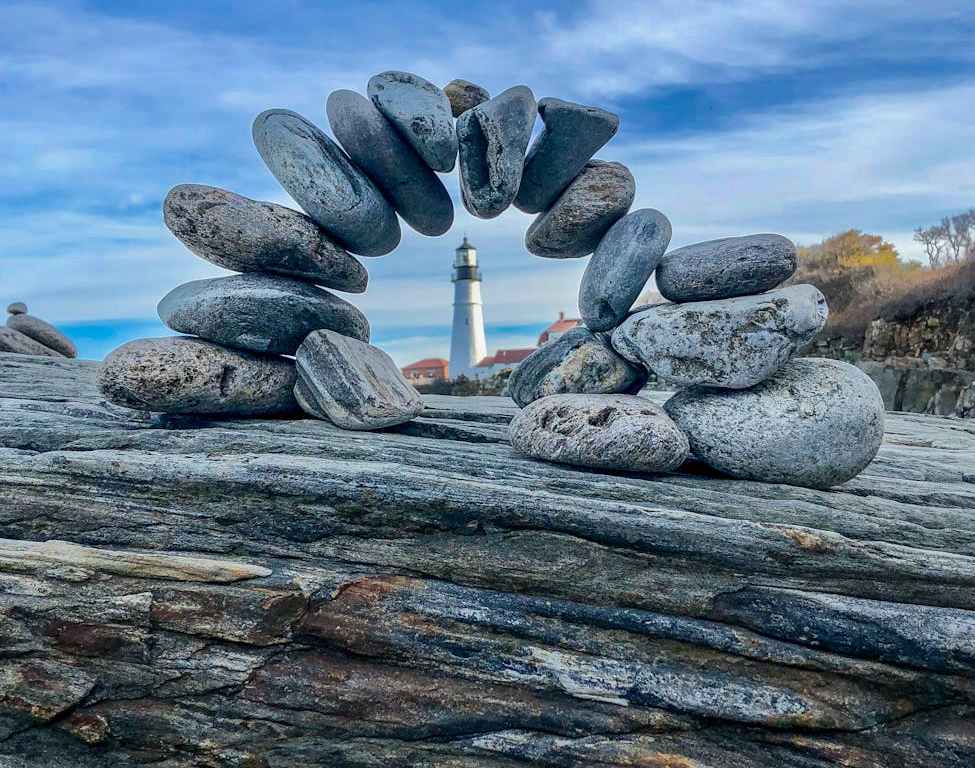
Unassuming, forgotten, and important. That’s what Len thought when he looked down at the stones, a dozen or so piled in a vague line to his right, an actual standing knee-high corner behind him to the left. Before him, a layer of pine needles and dry autumn leaves carpeted the old concrete floor; he pictured that as a pattern of an actual carpet, a runner up the center aisle between the pews and ending at the altar. No, he shook off the idea; he had pictures of the chapel from before it collapsed, and he could recreate the actual colors and materials just as they were. That’d be the right way to do this, to honor the history of the Poles who came here almost a century ago and built this as the center of their community. The original St. Stanislaus—unassuming, forgotten, important.
He spent the next few minutes sweeping off the foundation concrete with a pushbroom. It looked good, and the stability assessment he had paid for last year was still current. Just four walls and a roof, he thought, is all we need. He turned and walked back into the parking lot, toward the pale yellow concrete of the “new” St. Stan’s, its slanted roof topped by a conical steeple. From the beginning, the parishioners had accepted the structure with a cynical chuckle—”the party hat” and “the ice cream cone” were its most common monikers.
Inside, Father Piotr leaned over his writing pad. The page was messy, with words crossed out and notes in the column, but he always preferred to write his sermons by hand. He might be just a small-town parish priest, but from the beginning he thought of writing as part of his vocation. With his brother coming this weekend, it was a chance to show that his small-parish assignment was no indication that he wasn’t doing important work. But he would keep it short. He prided himself on always keeping his sermons brief and to the point; he thought long ones were self-indulgent. It was structured well now, starting with the Dietrich Bonhoeffer quote: “When God calls a man, he bids him come and die”—one of his favorites. He then laid out the rest in his typical format, following a single theme through paragraphs anchored by a quote from each of the readings and the Gospel. He just needed to add his own concluding note, something on sacrifice and change, and he’d have it.
Now, though, he had a 2 o’clock, Kerry Dunne, head of the parents’ committee for the CCD classes. That wasn’t something that had existed—the parents’ committee—until Kerry Dunne’s kids enrolled in their first classes. I wish, Piotr thought, that just a few of the parents on this regrettable committee would volunteer to actually teach the CCD classes.
He opened the door to the waiting room and greeted Kerry, who had her little daughter Mia in tow. Mia stayed in her chair, not looking up from the video game with its awful music on her phone, and Kerry came in and sat across the desk from the priest. “Thanks for seeing me, Father Peter,” she began—no one called him Piotr, and he had given up trying to correct it.
“Of course, of course. I did review your emails on the proposed schedule change for the first communion this year, and…”
“Right, right,” she interjected, “it’s just a proposed one-week change, and the parents’ committee overwhelmingly approves.”
“Yes, yes, sure. It’s just that the schedule is promulgated by the Archdiocese, and the Bishop has to be there for it…”
“Well, we could propose the change to them at least, right?” It was a question in structure, but not tone.
“I can send a message…”
“You know what? I’ll be in the city tomorrow anyway. I’ll just head over to the Archdiocese and see what I can get done”.
“Really, no need, I’ll contact them,” Piotr replied weakly, exhausted by the whole thing. He could use Kerry’s energy, though, for worthwhile projects, and one in particular that he believed in the most. “Have you gotten any more headway with the idea of the social justice committee? I’ve been trying to emphasize service themes in the sermons recently…. On that committee, we could really make an impact, go up to the shelters in the city to serve, more collections for food and clothing drives, even the bloodmobile. We could start getting the kids involved too, really show them what Christian service is…”
“Well, the parents’ committee has discussed it…” Kerry replied. “We think it would be best to gauge interest in a measurable way first, so we don’t get it started—attach our names to it—and then wind up not having the interest to sustain it. What about sign-up cards and a drop-box by the entrance at the Masses?”
“Great, great idea. We’ll do that. And again, no need to go to the Archdiocese, I’ll drop them a line.”
“Oh, no, I’ll be in the neighborhood, I’ll see what I can get done. Anyway, don’t let me keep you.” Kerry moved swiftly out of the room, grabbing her daughter by the hand, pulling her from her seat without breaking stride and moving on out the door to the parking lot. As they approached the car, they crossed paths with Len.
“Oh, hi Kerry. Is father Peter in?”
“Oh yes, yes, in his office. Honey, Say hi to Mr. Len? Remember, the mailman?”
Len smiled. “How are you, honey?”
The girl did not look up from her phone.
“Well,” Kerry smiled, “How are things? Hear from your son recently? We really hope he’s doing well. Business as usual here, it never stops, you know. How are you holding up, good? You’re still going to come over for dinner with me and Rob sometime, right? You’ll let us know?”
“Sure, sure,” Len barely got out the words before Kerry was in the car and starting the engine. He turned and headed inside.
“Father Peter, hey,” Len strode into the office with a smile.
The men shook hands, Piotr still in his seat.
“Len, how are you,” Piotr asked as he glanced back down at his sermon.
“Well, I wanted to talk with you some more about the chapel. I was thinking, you know, maybe it’s unassuming and forgotten, but it’s…”
“Well, Len, I appreciate your passion, I do. I just, you know, we’re very busy now and I’m not sure we’re going to get the funding or manpower to get this going.” He sighed. “We’re still really focusing on this social justice committee, you know. Get people engaged in service, maybe up in the city.”
“Understood, sure, sure,” Len wanted his facial expression to convey how much he was considering everything. “I mean, as I said, I grew up…my dad was a stoneworker and stone mason, and I helped out a lot all the way into my twenties, so I’m glad to kind of take lead on it. I’ve got the time now too, with the retirement and, you know, since my Kay passed last year…. Anyway, I’ve even found a place to source the materials, you know Nowak Building Supply out on Route 10, that’s Tommy Nowak’s cousin, from here in the church. He’s got some stones that will work out great; they got them for that new farm-to-table restaurant in downtown, but then they decided to go with the veneered stone walls, so now we have these at a big discount. There’s enough to get the project started at least, and we can order in the rest as long as we’re willing to put a deposit down.”
“Right, great, that’s good to know, all that,” Piotr really wanted to get this sermon finished. “We’ll see, OK. Let’s see how things go, OK?”
“OK,” Len smiled. “Well, thanks for seeing me, and we’ll see you Sunday….”
. . .
Standing at the lectern that following Sunday, Piotr felt a familiar confidence that was so lacking in the managerial aspects of his job. Here, he was the writer-priest, an intellectual refreshing the parishioners with a sermon that was interesting instead of sleep-inducing, uplifting and thought-provoking instead of hectoring. He began:
Before his execution by the Nazis, the German theologian Dietrich Bonhoeffer presented us with a concept that became only the more compelling with the circumstances of his death: ‘When God calls a man, he bids him come and die.’ In their own way, today’s readings ask us to consider the same idea.
In the first reading, Jeremiah testifies to the irresistibility of sharing his faith, despite the cost. ‘The word of the Lord has brought me derision and reproach all the day. I say to myself, I will not mention him, I will speak in his name no more. But then it becomes like a fire burning in my heart; imprisoned in my bones; I grow weary holding it in, I cannot endure it,’ he tells us.
In the second reading, Paul’s message places the idea of faith in the context of a specific place and time, exhorting us: ‘Do not conform yourselves to this age but be transformed by the renewal of your mind.’
And finally, the Gospel brings these threads together: place faith at the center of your life, be willing to pay the cost, and experience true transformation. ‘Whoever wishes to come after me must deny himself….whoever loses his life for my sake will find it.’
Transformation is the call, be it unto death or merely in the way we live our own lives. Whether struggling like Jeremiah in speaking of the Lord in a world that mocks you for it, whether engaging in the renewal of ourselves despite the pressures of our age; indeed, even when the call to die in Christ means actual death, as it did for Bonhoeffer, we each must transform, give up ourselves, ultimately finding life anew through Christ. So today we must each ask: what do we give up, what do we forgo in order to truly transform our lives, our world?
With this Piotr closed the cover of his book, looked down, and waited, feeling the gratification of a job well done, wanting the solemnity of the silence to drive home his message. He walked back to the altar and resumed Mass.
Sitting at the end of a pew about three rows from the back, Len liked the sermon, thought maybe it was, at least a little bit, about him. Perhaps Father Peter had begun to soften on the chapel idea, he decided. After all, reconstructing it would require a great sacrifice of time and effort, and it would transform St. Stan’s. Still enjoying this thought some minutes later, Len noticed over his shoulder that the collectors were lining up by the hand-baskets at the back of the Church, one in the middle aisle and one back to the left, but nobody for the right side. Might as well help out, he thought, and slid out of his pew to walk to the back. Seeing the head usher John upon his arrival in the entryway, Len offered, “Hey John, need someone for the right side?”
“Len the mailman! No, no, we’re all set.”
Len tilted his head and peered at the unattended hand-basket leaning against the wall behind the back right pew, gave it a silent nod. Turning back, he started to speak, but John interrupted.
“We’re definitely all set, Len. Enjoy the Mass.”
Just then another man came back into the entryway, greeting John warmly. He was a stranger to Len, which was odd given the small size of the parish.
“Right over here, all yours, buddy,” John explained to the man as he walked him toward the last hand-basket.
Len walked back into the church but stopped short, seeing someone had taken his seat. He pressed himself against the back wall, scanning for a new place in a pew. Seeing nothing, though, he resigned himself to stand there in back for the rest of the Mass. As the music started, the three collectors made their walk up their respective aisles, and John emerged from the entryway, watching the collectors. Seeing Len, he leaned over and whispered, “Len, buddy, I told you we don’t need you.”
“Yeah, I know,” Len replied, “I just lost my…” but John had already walked away.
After the collection, Len, from his standing spot along the back wall, could hear the three collectors and John back in the entryway, pouring the baskets into one collection bag for the safe, laughing at inaudible jokes. He made out a “next week” in John’s voice just as the four men emerged back into the church and fanned out to return to their separate pews. Walking directly by Len, John shifted his eyes in his direction without quite looking at him and exhaled slightly.
Piotr concluded Mass with a procession down the middle aisle to the entryway, where he stood as always at the outside door to greet the departing parishioners. As his brother emerged with his wife and two children, he grasped Piotr’s hand and smiled. “Quite an interesting sermon.”
“Oh, thank you,” Piotr replied. “I thought it went well.” He did think that, and felt happy.
“I don’t think I would have used the Bonhoeffer quote, though—a bit much,” continued the brother, turning his head to look off into the street.
“Well, it’s a compelling story,” Piotr replied, “so I thought it would really drive home the theme…”
“Sure, I guess. You know our priest in the city gave a great sermon last week; he always posts them on the parish website, you should check it out.”
“Sure, sure.”
“Come to think of it,” the brother smiled, “I could put you two in touch. He could share some tips.”
“Ah,” Piotr swallowed. “That’d be great.”
“So,” the brother shifted subjects, “are you coming to lunch?”
“Sure, I’ll meet you there.”
Leaving Mass, Len picked up coffee and donuts, as he did every Sunday at that time, and called his son.
“Dad,” said the son, “you should come visit…”
“Well,” Len offered carefully, “I’ve got this chapel project, I’d like to get at least a little bit of the walls done before winter, show the parish some progress. Hey, maybe you could come and help out with it sometime, what do you think?”
“Oh, ok, yeah,” his son’s quick agreement surprised Len. “That sounds like fun. I could, um, maybe next week or so I could get down there…”
. . .
The next morning, Len drove over and bought that first batch of stones. Now they could make real headway, he and his son working together. And it would be a lot more time than they’d spent together at any point in the last year.
At the same time, Piotr made his Monday walk from the seminary to his office in the back of the church. He’d review the week’s readings and Gospels, sketching out sermons, spending most of his time of course on next Sunday’s message. But first he retrieved the drop-box from the church entryway. Just like Kerry had suggested, he had put it out, along with sign-up cards for the social justice committee, and asked the parishioners, during the announcements at the end of each Mass for almost a whole week, to please sign up for this important initiative. Arriving at his desk, he placed the box down, unlocked it, and opened the top. There was a single sign-up card, folded in half. He sighed, and unfolded it. The lines for “Name” and “Contact Info” were empty, and in a space below labeled “Specific Volunteer Interest” was written: “shorter sermons, please!” Piotr stared at it without moving for some seconds. His hand dropped to his side, and he looked out the window to the parking lot, seeing Len’s truck, the back filled with building stones, pull up next to the remnants of the old St. Stan’s.
He walked to his closet, changed into a sweatshirt and jeans, and exited into the parking lot. As he drew nearer to the little chapel site, he saw Len unloading the back of the truck. Just stones now, but soon enough a standing chapel. Proof always in the potentiality. Just then, Len looked up and noticed him, and smiled.
Bio:
Kevin Duffy is the author of the “Europe in These Times” series at Dappled Things. He writes from Alicante, Spain.
Discover more from PAROUSIA Magazine
Subscribe to get the latest posts sent to your email.


